Blog / GMC

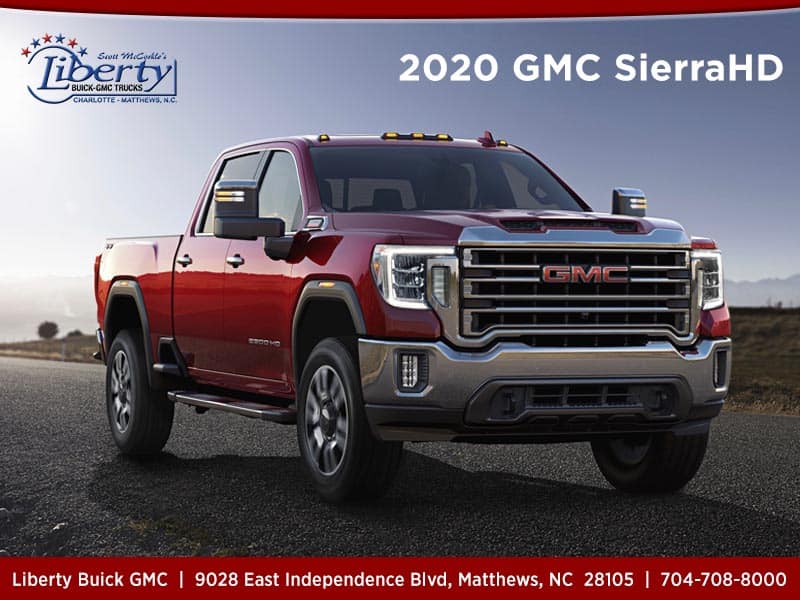
Defy Convention with the 2020 GMC Sierra 2500HD

GMC Sierra 2500HD
Are you in the market for a new heavy-duty truck? GMC has you covered from top to bottom with the new Sierra 2500HD. At first glance, the 2020 Sierra 2500HD—which is in its first year of a new body structure—is as impressive as they come. And once you get into the details of its capabilities and features, it doesn’t disappoint. In short, it’s powerful yet refined—sophisticated yet practical. This article will discuss the 2020 Sierra 2500HD’s remarkable towing performance, its beautiful and functional exterior and interior features, and the various trim levels and their pricing.   THE TOWING Perhaps the most impressive aspect of the new Sierra 2500 HD is its towing capabilities. Let’s dive into the details:   Trailering Capabilities The Sierra 2500HD can tow up to 30,000 pounds, which is quite a jump from the 2019 models of 23,300 lbs. It’s clear that GMC focused on attracting customers who are looking to pull a trailer. This is the first year that the automobile manufacturer has assigned the Sierra HD models its own chief engineer and development program; in times past, their development was seen simply as an extension of the Sierra 1500. Jaclyn McQuaid, the chief engineer, noted that trailering was the focal point in the Sierra HD’s design process, pointing out that the 2020 models have “a beefier driveline and suspension, a stiffer frame, larger axles and propshafts, and an enhanced cooling system.” In other words, it’s built to be a towing juggernaut.   The Powertrain  Of course, no features will allow for impressive towing capacity like a truck’s powertrain, and the Sierra HD has it going on in that department. The available 6.6-liter Duramax turbo-diesel V8 produces 445 horsepower and 910 lb-ft of torque. While these are the same numbers as previous models, this engine has been designed for higher efficiency in the 2020 Sierra 2500HD. For instance, there is a bigger radiator and fan for extra cooling capacity, as well as, enhanced air induction. One of the most impressive aspects of the powertrain is the new Allison 10-speed automatic transmission, which is being offered for the first time in this line up of HD pickups. With closer gear spacing than ever before, the engine is able to consistently run at the perfect level, no matter the towing load or terrain. This is also the first year that GMC is offering a 6.6-liter engine that runs on gasoline in their HD trucks. The 6.6-liter gasoline direct-injected V8 engine is exclusive to GMC, and it delivers 401 hp and 464 ft-lb of torque. This is an 11% and 22% increase in hp and torque, respectively, from the 6.0-liter gasoline engine of previous models. Customers who opt for the 6.6-liter gasoline V8 will get the 6L90 six-speed automatic transmission. Finally, the powertrain improvements for the 2020 Sierra 2500HD include bigger and stronger rear axles, which helps to provide maximum torque to the ground, as well as, better gross axle weight ratings (GAWR). The front axles are also bigger and stronger in general, and an 11.5-inch ring gear comes standard on all 2500HD models.   Transparent Trailer View Along with more power to pull a trailer, the new Sierra HD features one of the most exciting new technologies in the industry today: transparent trailer view. GMC calls it the ProGrade Trailering System, and it essentially renders the trailer invisible behind the truck. This has obvious advantages for trailer haulers from experts to novices. By using various combinations of 15 cameras, the trailering system is designed to simplify every aspect of trailering. Seeing through the trailer allows for easier and safer maneuvering in traffic, backing up and parking. The system even offers a close-up of the hitch, making coupling a breeze. Furthermore, the ProGrade Trailering System includes:
  • Lights for the hitch area
  • Automatic parking brake assistance
  • Integrated trailer brake controller
  • A mobile app with a departure checklist, tire pressure monitoring, theft notifications and many other features
  Hauling Capabilities GMC also worked to improve the 2020 Sierra HD’s hauling capabilities and to make loading and unloading cargo as practical as possible for customers. For one, it now leads its class in cargo- bed volume and offers 12 corner tie-downs, and you have the option of adding a 120-volt power outlet in the bed. The cargo bed railings are an inch lower than the 2019 Sierra HD models, which lends to an easier liftover. Additionally, the truck has steps on the sides of the bed and on the corners of the rear bumper—roughly the size of a work boot—so that customers can have better access to objects inside the bed. Moreover, higher trim levels of the Sierra HD showcase the new MultiPro six-function tailgate that was introduced by GMC on the 1500 models this year; however, the version of the tailgate found on the 2500 is designed specifically for the HD models.   THE EXTERIOR Now that you know the gist of the towing capabilities, let’s take a look at the exterior characteristics:   Body Construction  2020 marks the beginning of a new era of body style for GMC pickups; overall, it’s larger and more aggressive than ever before. The contrast between the Sierra 1500 and 2500HD is more apparent than in previous years, as the latter now stands 2 inches taller and stretches 10 inches longer than its 2019 version. Additionally, the hood line is elevated, and the grill is an entirely different thing altogether. While GMC has received some criticism for the redesigned grill on the Sierra (as with the Chevrolet Silverado), there’s no question that it makes a statement: a bold, unapologetic statement with lots of chrome and character. The grill is massive, and it’s capped by a hood scoop that adds to the overall appeal of the truck. The hood scoop is also designed to assist the new cooling system that comes with the Duramax turbo-diesel engine. Another component that adds to the Sierra HD’s aggressive look is the LED lighting, which is everywhere. This includes headlights, taillights, roof marker lights and fog lights (available through upgrade). Moreover, the roof has four yellow running lights, and each wheel-well flare has an orange side marker at the top.2019-GMC-trucks   Colors There are eight primary colors to choose from for the Sierra HD models:
  • Summit White
  • White Frost Tricoat
  • Quicksilver Metallic
  • Onyx Black
  • Carbon Black Metallic
  • Pacific Blue Metallic
  • Dark Sky Metallic
  • Red Quartz Tricoat
  THE INTERIOR  There’s more to the 2020 Sierra HD than it’s attractive and functional exterior; it’s also built to impress on the inside:   Roominess Driver and passenger comfort is a big part of the Sierra HD’s appeal. GMC has stepped up their game in creating more room in the cabin. In fact, the 2500 crew cab models are now top of the class for front head and legroom. Also, there are three more inches of legroom in the rear-seat than there were in previous models. If you’re one of the 90% of GMC customers who choose a crew cab body style, this extra room could prove critical in your riding experience—particularly on longer trips.   Seats and Trim The cabin in the Sierra HD models is built on the same construction as the Silverado. However, that’s where the similarities end. As with many other specs, GMC puts their unique touch on their cabin features, and the new Sierra HD is no exception. For starters, the seating profile is higher than in recent years, which provides increased visibility on the road and, perhaps, a greater sense of safety. While the base model is satisfyingly upscale, the most elaborate interior comes in the Denali edition, which sports large pebbled grain leather upholstery with contrasting stitching, and no truck will have identical-looking seats. Also, the trim on the Sierra HD Denali comes in authentic open-pore wood with dark aluminum decor.   Technology  You’ve read about the ProGrade Trailering System, which is intelligently integrated into the Sierra 2500HD’s computers. But that’s not all the impressive technology the truck offers. There are 15 cameras in total, which come in handy even when you’re not hauling a trailer. For instance, you can see an overview of the truck, inspect the cargo in the bed, and see along the wheels as you parallel park. Additionally, a coinciding mobile app called MyGMC offers several functions that assist with pulling a trailer and keeping the trailer in good condition (e.g., controlling temperature, monitoring tire pressure, checking trailer lights, controlling the integrated brake system, etc.). Furthermore, you can opt for a 15-inch head-up screen that displays important functions such as an odometer, an inclinometer, trailer info, and navigation instructions, among others. And let’s not forget about the optional Rear Camera Mirror and HD Surround Vision camera system.   THE TRIMS AND PRICING The 2020 Sierra 2500HD comes in five trim levels: The base model, SLE, SLT, AT4 and Denali. Prices for these trims, along with a plethora of configurations, differ as much as $30,000.   Base Model, SLE, and SLT  The base model Sierra 2500HD starts at $37,195 MSRP, which is the least expensive option we’ve seen for a GMC Heavy Duty truck in years. The Sierra 2500HD comes as a regular cab/long bed model, and it is basically GMC’s version of the Silverado Work Truck. The price goes up to $41,595 if you opt for a crew cab with standard bed, and you can add a long bed for $200. The SLE is one step above, meaning it has a few niceties not included in the base model. Starting at $41,595 (regular cab/long bed), you can get a crew cab with standard bed for $45,395. Again, adding a long bed to the crew cab model is just $200. The SLT is the Sierra 2500HD’s middle trim level, and it reflects both in price and features. It comes stocked with a double cab and standard bed for $52,195, and you can upgrade to a crew cab/standard bed for $53,995.   AT4 This trim is all new to the GMC lineup of trucks. The AT4 was designed with off-roaders in mind. It comes with unique exterior and interior features (e.g., exclusive paint colors, dark chrome grill and trim, jet black upholstery, etc.), as well as some practical upgrades that make it worthy of its all-terrain title. For instance, the AT4 is stocked with an off-road suspension, locking rear differential and skid plates. It also comes with an off-road mode you can select for the traction control system. Furthermore, it boasts a hill start assist and hill descent control. The AT4 comes only in the crew cab model, which starts at $59,295; it’s $200 to add a long bed.   Denali The Denali is the Sierra’s luxury trim, and has been since 2001. Along with some of the interior perks mentioned previously, the Denali comes with an enlarged chrome grill and 20-inch chrome wheels, among other features. Limited to crew cab form, it starts at $65,295, with the option of adding the $200 long bed. If you’re looking for muscle and appeal in a truck, don’t settle for anything less than the 2020 GMC Sierra 2500HD. It has towing and hauling capabilities to compete with any pickup in its class, and its innovative trailering technology is second to none. And let’s not forget its bold, attractive and functional exterior and interior. Be sure to come out to Liberty for a test drive, and find the trim level that works best for you!   -Alex Watson

Posted in:

Related Posts

Car Theft Prevention in Charlotte: GMC Anti-Theft Features and Tips

How to Protect Your Car in Charlotte: GMC Anti-Theft Features and CMPD Tips

Charlotte Car Thefts Are Down 31%. Here's How to Stay on the Right Side of That Number According to Charlotte Mecklenburg Police Department (CMPD), there were 2,163 vehicle thefts in Charlotte during the first six months of 2026. That works out to approximately: 83 vehicles stolen every week. Almost 12 vehicles every day. And that's actually good news compared with last year: CMPD says vehicle theft was down 31% during the first half of 2026. In the same six-month period of 2025, there were 3,127 vehicle thefts. Good habits are the first line of defense, but newer GMC vehicles also offer technology designed to make stealing the vehicle more difficult and help owners respond if a theft occurs. CMPD recommends: Always lock your doors and completely roll up your windows. Never leave the vehicle running unattended, even briefly. Take your keys with you, including valet keys, and never hide a spare key in or underneath the vehicle. Remove valuables from the vehicle entirely. CMPD specifically mentions phones, purses, briefcases, backpacks, cash and even loose change. When shopping, put packages in the trunk rather than leaving them visible inside the passenger compartment. Do not leave registration or insurance cards in the vehicle. Park in a well-lit area, preferably somewhere with surveillance. At home, park in the driveway rather than on the street when possible. Consider an alarm or other theft-deterrent device. CMPD specifically recommends a steering-wheel lock as an additional theft deterrent. They say locks may sometimes be available free from CMPD division offices, depending on supply. Even common sense and good law enforcement advice can’t prevent every incident, but it pays to know the facts. In addition to good habits did you know that GMC vehicles come with many anti-theft and security features built in?  Moreover, GM offers OnStar plans that fit your lifestyle and your budget. At Liberty Buick GMC, our inventory offers a range of available anti-theft and security features. Some come standard and are ready to drive off the lot, unless, of course, you’re stealing them. Anti-theft & Security Features Defined: Theft-Deterrent System (Alarm) The car's built-in alarm. If someone opens a door, hood, or trunk without the key fob, or breaks in, the horn honks and the lights flash to scare them off. It arms itself when you lock the vehicle and shuts off when you unlock it with your fob. Engine Immobilizer A digital handshake between your key fob and the engine. If the car doesn't recognize your fob's unique code, the engine won't start, even if a thief gets inside or tries to hot-wire it. OnStar Basics GM's entry-level connected-services package, usually included on new vehicles for a set trial period. It covers core safety and security services, like crash notification and stolen vehicle help. Some extras (like remote app commands or Wi-Fi) may need a paid upgrade after the trial. Automatic Crash Response If the car detects a serious crash (like an airbag deploying), it automatically contacts an OnStar advisor. The advisor tries to reach you, and if you don't answer or need help, they send emergency responders to your GPS location. Remote Vehicle Commands (Lock/Unlock, Start, Locate) Using the myGMC app on your phone, you can lock or unlock the doors, start the engine (handy for warming up or cooling down), or find the car, all from wherever you are. Locate can also flash the lights or honk the horn to help you spot it in a parking lot. Vehicle Location The vehicle's GPS tracking. It lets you (in the app) or OnStar (if you report a theft) see where the vehicle currently is, so you're never guessing after a theft or a forgotten parking spot. Stolen Vehicle Assistance If your vehicle is stolen, you report it to police, then call OnStar. Advisors work with law enforcement to use the vehicle's GPS to track it down and help get it recovered. Stolen Vehicle Slowdown Once police are involved and confirm it's safe to proceed, OnStar can gradually reduce the stolen vehicle's engine power so it slows to a stop. It doesn't shut the engine off suddenly, which avoids putting the thief or others in danger, and it ends a chase before it starts. Remote Ignition Block If the stolen vehicle is turned off, OnStar can send a signal that prevents it from being restarted. The thief is left with a car that won't go anywhere until police arrive. HD Surround Vision / Security Cameras A set of exterior cameras stitched together into a bird's-eye view on your screen. It's mainly a parking and maneuvering aid, helping you see around the vehicle, but it also gives you better awareness of your surroundings. Actual "security camera" recording features vary by model, so confirm what your trim includes. Teen Driver Parental controls for the car. When a teen's key fob is registered, you can set speed alerts, cap the audio volume, and keep certain safety systems switched on. The car can also give you a "report card" of their driving habits, like hard braking or speeding. It can even mute the radio until seat belts are buckled. Super Cruise GM's hands-free driving assistance for compliant highways. It steers, accelerates, and brakes while you keep your eyes on the road. A driver-facing camera watches your attention and alerts you if you look away too long. It's a convenience and safety feature, not an anti-theft one. 2026 GMC Anti-Theft & Security Cheat Sheet Feature What it does Needs OnStar plan? Theft-Deterrent System (Alarm) Honks and flashes lights if a door, hood, or trunk is opened without your fob No Engine Immobilizer Engine won't start unless it recognizes your fob's code No OnStar Basics Entry-level connected services (crash and theft help), usually a trial period Yes (trial, then paid) Automatic Crash Response Detects a serious crash and connects you to an advisor, who sends help to your GPS location Yes Remote Vehicle Commands Lock, unlock, start, and locate the vehicle from the myGMC app Yes Vehicle Location GPS tracking so you or OnStar can see where the vehicle is Yes Stolen Vehicle Assistance OnStar works with police to track and recover a stolen vehicle Yes Stolen Vehicle Slowdown With police involved, OnStar gradually reduces engine power to stop the vehicle safely Yes Remote Ignition Block Prevents a stolen vehicle from restarting once it's turned off Yes HD Surround Vision Bird's-eye camera view for parking and awareness (not a recording security system) No Teen Driver Speed alerts, volume limits, and a driving "report card" for registered teen fobs No Super Cruise Hands-free highway driving with a driver-attention camera (convenience, not anti-theft) Yes (subscription after trial) Ready for a GMC with more than performance, comfort and style in mind? Visit Liberty Buick GMC in Matthews to explore our selection of new GMC vehicles and the anti-theft and security features available on each model. Our team can show you what comes standard, what additional protection is available and help you find the GMC that fits the way you drive. Because the best vehicle security starts before you ever leave the lot.

2024 GMC Acadia VS Honda Pilot

The 2024 GMC Acadia vs The 2024 Honda Pilot

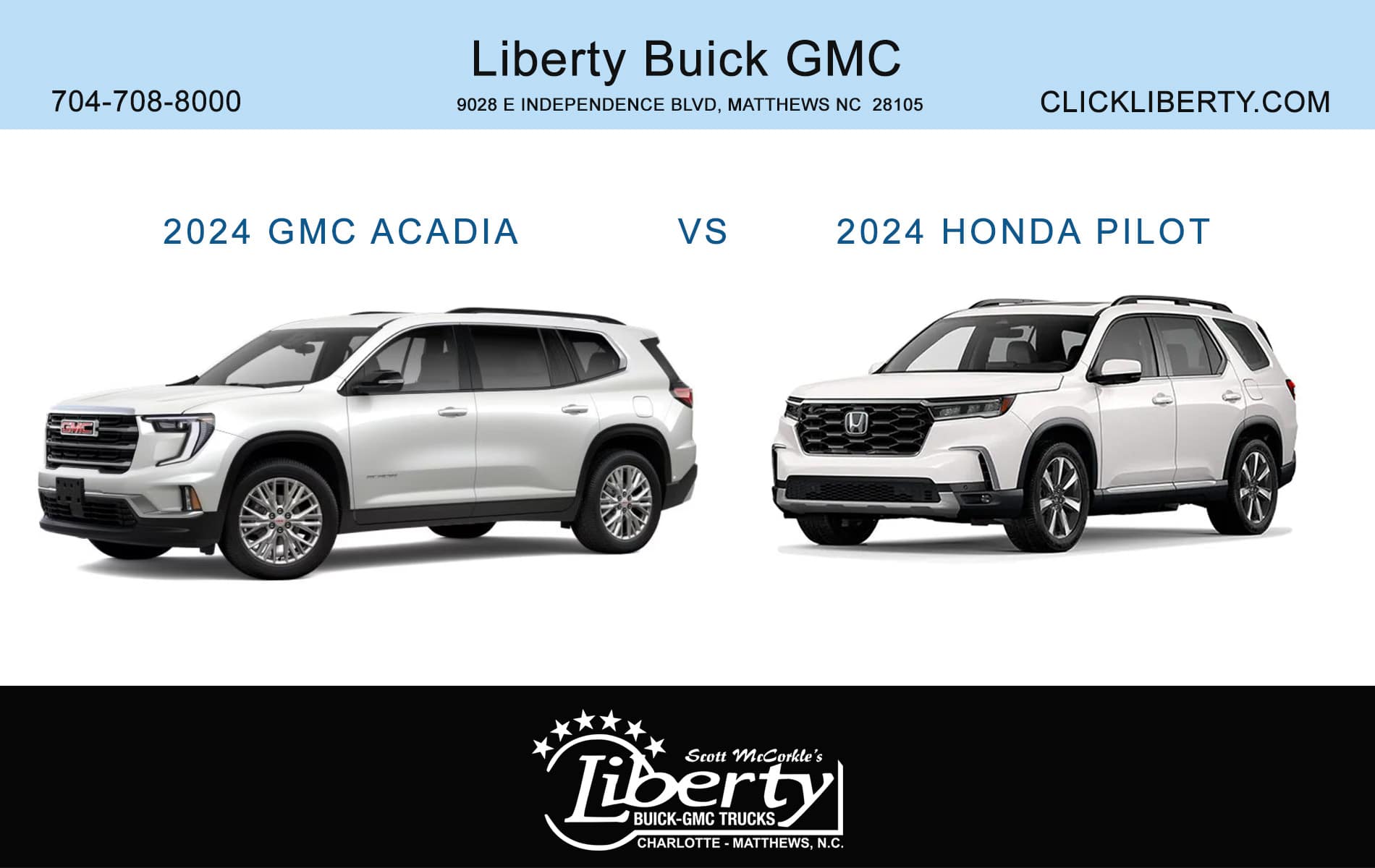
The 2024 GMC Acadia vs The 2024 Honda Pilot Two stalwarts in the SUV game, the GMC Acadia and the Honda Pilot both boast big sales and happy drivers. But of the two, which is the better purchase? It’s hard to say which is better with vehicles so similar, and individual tastes will ultimately determine which is best for you, but there are a few clear distinctions between the two that might catch your attention. A Quick Comparison In terms of comfort, the 2024 GMC Acadia and the 2024 Honda Pilot both offer about the same in comfort, but the 2024 Acadia has a little more head- and legroom, making it slightly roomier than the 2024 Pilot. In terms of convenience, you will make less stops at the gas station with the Acadia, which saves you money in the long run as well. When considering the price tags for these two vehicles, the Manufacturer’s Suggested Retail Price is lower for the Acadia than it is for the Pilot–this is yet another check for GMC. Specifically, the Acadia has an MSRP of $36,800-$50,600 while the Pilot’s suggested cost is around $39,900-$54,280. looking at the dimensions and handling, there are some bigger differences between the two. For example, the 2024 Acadia is slimmer in size than the 24 Pilot, making the GMC much easier to navigate through tight quarters and tricky parking spaces. The Acadia is also shorter in length than the Pilot, which adds to the ease of navigating around town. Though the Acadia is slightly smaller in size, it has a larger turning radius than the Pilot. This adds to the ease of driving the GMC, as maneuvering in and out of tight spots is easier. When it comes to performance, the Pilot has more horsepower than the Acadia, but due to the Acadia’s higher torque, it does a better job than the Pilot of transmitting the engine’s horsepower to its wheels. The Specifics Here is a breakdown of the specs for the two vehicles so you can get a better picture of how the 2024 GMC Acadia and the 2024 Honda Pilot differ from each other. Miles Per Gallon–City Acadia: 19-22 MPG Pilot: 18-19 MPG Miles Per Gallon–Highway Acadia: 26-29 MPG Pilot: 23-27 MPG Seating Acadia: 7 seats Pilot: 7-8 seats Cargo Space Acadia: 79 cubic feet Pilot: 86.5-87 cubic feet Engine Acadia: 228 horsepower, 2.0-liter, 4 cylinder (gas) engine or 310 horsepower, 3.6-liter, 6 cylinder (gas) engine Pilot: 285 horsepower, 3.5-liter, 6 cylinder (gas) engine Drivetrain Acadia: All wheel drive/front wheel drive Pilot: All wheel drive/front wheel drive Exterior Length Acadia: 193.4 inches Pilot: 199.9-200.2 inches Exterior Width Acadia: 75.4 inches Pilot: 78.5 inches Legroom Acadia: front–41 inches; rear–39.7 inches Pilot: front–41 inches; rear–40.8 inches Head Room Acadia: front–40 inches; rear–39.6 inches Pilot: front–39.1-40.5 inches; rear–39.2-40.2 inches The 2024 GMC Acadia Our winner between the Acadia and the Pilot is the 2024 GMC Acadia. And it’s not only us who thinks this way, the all-new Acadia is turning heads and impressing car reviewers with its multiple trim levels: The Elevation, Elevation Premium, AT4, and the Denali trims are all packed with incredible features and capabilities. Here is a closer look at the four trim options you have when purchasing the 2024 GMC Acadia: Elevation To be fair, all four trims are substantial and impressive. To call the Elevation the base-trim level implies it’s bare bones, but this couldn’t be further from the truth. At this first level, the Acadia is powered by a 2.5-liter turbocharged engine with 328 horsepower and 326 lb-feet of torque, and you have the option to go with 7- or 8-passenger seating. Most notably, it comes with a 15-inch diagonal premium GMC Infotainment System at no extra cost. Yes, you read that correctly. You do not have to pay for this as an add-on feature since GMC decided to put its most advanced touchscreen in the base level of the Acadia at no extra cost. Maybe we should consider the Elevation as the not-so-base trim level. Elevation Premium Picture this: a brand new SUV with 20-inch wheels and an immaculate interior with fold-flat captain’s chairs (in the back row) and about every technological feature you can imagine. This is the 2024 Acadia Elevation Premium trim level. It also comes with Smart Slide so you can manipulate interior seating to fit your specific needs. What is most impressive with Elevation Premium is the Super Cruise, one of the most advanced automated driving systems on the market today. This is one of our favorite safety features, as it enhances the regular cruise control by incorporating specialized sensors and radar technology so that your car can adapt to the driving conditions around it. For example, once you have set the preferred distance between your car and those ahead of it, Super Cruise will speed your car up or slow it down in order to maintain that distance. AT4 Consider the AT4 as the Off-roading package. This adventurous trim level comes in a dark-accented exterior color, a new Forest Storm interior, and a new rugged suspension design that allows for extreme off-roading. The 2024 Acadia AT4 comes with a raised suspension, but just how raised we do not know yet, as GMC has not officially announced how high the AT4 will sit. You can trust that this version of the Acadia will be tougher than it has ever been though. When GMC goes rugged, they go all out. Denali GMC’s most popular trim level is the famous Denali level. The Denali always comes fully loaded, as in everything you could imagine being packed into an SUV, this one has. Not to say it’s gaudy or busy, it’s actually quite luxurious and sophisticated, yet accessible to anyone. On the exterior, it comes with 20-inch aluminum wheels and the classic Denali grille with Galvano silver accents through the exterior body. Inside, there is premium leather seating that might be the most comfortable in any high-level SUV. Since the Denali trim level has been around for some time, and largely celebrated since its creation, you can trust that GMC has not pulled any punches with the 2024 model. A word to the wise–when you test drive the Acadia’s, don’t start with the Denali, start with the Elevation and work your way up the levels. If you drive the Denali first, you probably won’t want to drive anything else. It may be hard to believe but there are plenty more optional features to be added on to the 2024 Acadia’s trim levels. Here are a few of our favorites: Enhanced Automatic Emergency Braking When driving below 50 miles per hour, this feature will alert you if there is the potential for a front-end collision, and it will also automatically apply emergency braking if the driver does not respond quickly enough. Safety Alert Seat This specialized seat vibrates and pulses at the bottom of the seat for various warnings—this is an option instead of having auditory or visual warnings. This is a great option to keep you safe when you have a car full of talkative kids, or you feel like blasting your favorite song. Front and Rear Park Assist Park assist detects objects or people around you when you are driving at low speeds. Typically, it gets used when parking or navigating through congested areas. We have found this feature to improve even the worst of parallel parkers. High Definition Surround Vision This digital bird’s-eye view comes at high definition and gives a crystal-clear image of the area around your vehicle when driving at low speeds. The image of your area pops up on the Infotainment display, helping you to avoid objects and perfectly park in just about any spot. Stop in and see us at Liberty Buick GMC today and test drive all four styles of Acadia to see which is the best fit for you.

ADAS Service Repair Center

Everything You Need to Know About Advanced Driver Assistance Systems (ADAS)

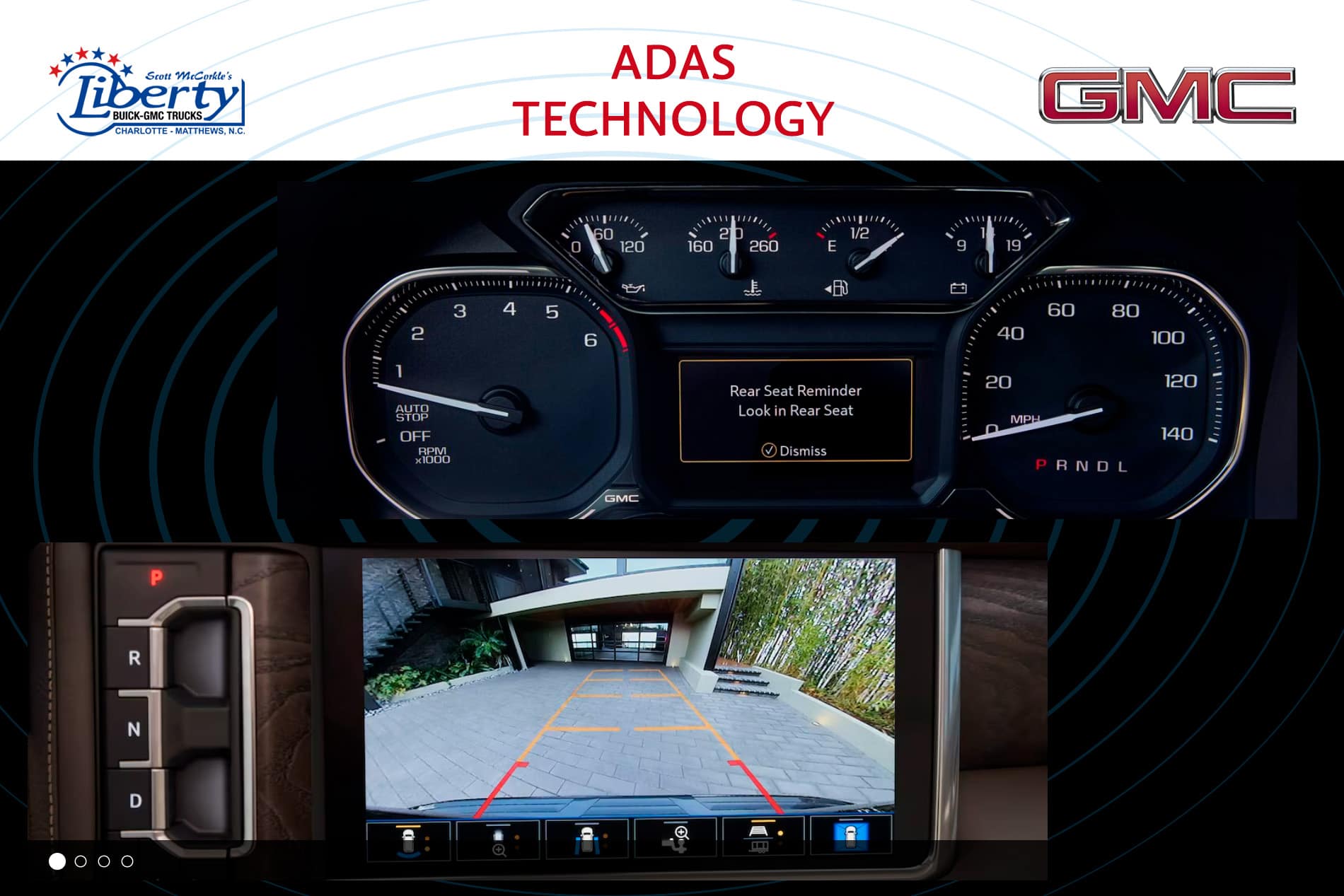
As artificial intelligence continues to advance and integrate itself into the automotive industry, we find ourselves experiencing a much different driving experience than ever before. We can now communicate with our vehicles, even before we enter the car, to heat or cool the interior, to play our favorite music and podcasts, and we can now rely on AI to take care of some of the more complicated aspects to driving, such as the act of driving itself. Car drivers are entering the age of driver assistance systems, which are AI-integrated programs created to take over some of the more laborious aspects of driving. It is safe to say that we are entering a period in time where both humans and AI team together in order to create a brand new driving experience–one that is easier and safer for everyone. Advanced Driver Assistance Systems, or ADAS, are various technologies created to improve the driving experience, namely to promote vehicle safety. This process involves the implementation of automated assistance to the driver in order to help reduce the possibility of human error. This is done by using sensors, cameras, radar, and other advanced tech features to monitor the vehicle’s surroundings at all times and to assist in various driving tasks–such as adaptive cruise control, lane-departure assistance, automatic emergency braking, and parking assistance. For some car companies, like GMC, these advanced systems are nothing new, though they are being updated often. The availability of specific assistance features can depend on the trim level and options chosen for each vehicle, but a variety of them can be found in most versions of GMC’s Sierra, Yukon, Terrain, Acadia, and Canyon. Before we get into some details on how these systems work, let’s have a look into how incorporating ADAS can benefit both drivers and passengers: Improved Safety: we can already see how ADAS helps prevent car accidents by providing safety assistance to drivers through the use of emergency braking, lane departure warning, and adaptive cruise control. Enhanced Convenience: ADAS can make the driving experience more comfortable and less stressful by assisting with tasks such as maintaining a safe distance behind other vehicles, keeping your vehicle centered in its lane, and aiding in parking maneuvers, such as the dreaded parallel parking. Reduced Driver Fatigue: by incorporating ADAS, drivers can get alerts and assistance when necessary if experiencing fatigue. These technologies can keep drivers from falling asleep and/or get them to pay attention to certain aspects of driving–for instance, if there is flooding, icy conditions, animals crossing, etc. Potential Insurance Discounts: some insurance companies offer discounts for vehicles equipped with ADAS, as these technologies have already proven their ability to reduce the likelihood of accidents and even minimize potential damage in the case of an actual collision. Environmental Benefits: certain features to ADAS, such as adaptive cruise control, can help with fuel efficiency by maintaining a consistent speed and following distance. Over time, this can lead to a drastic reduction in fuel consumption. Lower emissions means your car is better for the environment, and you are able to save money by vising the gas station less often. Assistance for Drivers with Disabilities: ADAS can provide helpful assistance to drivers with disabilities by helping them operate aspects of the vehicle through automated prompting, the use of warning lights, etc. It can also assist those with limited mobility by setting itself to take care of things like the usage of blinkers and headlights without the prompting of the driver. Clearly, ADAS plays a crucial role in improving road safety and enhancing the driving experience, and this process of technological integration is only starting–who knows what the future holds! How ADAS Works Integrated systems such as ADAS are quite complicated, but gaining a basic understanding of how they work can better inform drivers on how and when to use them. On the most basic level, ADAS uses a combination of sensors, cameras, radar, lidar, and software algorithms to monitor the vehicle’s surroundings. All of these technologies are used to assist the driver. Here is a general overview of how it all works: Sensors and Cameras– Small sensors and cameras are strategically placed around the vehicle so that they can continuously collect data on the car’s surroundings, including nearby vehicles, pedestrians, road markings, traffic signs, and obstacles. Data Processing– The data collected by sensors and cameras are processed in real-time through the use of onboard computers. These computers use special algorithms to analyze the data received in order to identify objects on or around the road, detect potential hazardous situations, and to assess the vehicle’s position in relation to the road and other vehicles. Decision Making– Once incoming data has been processed, ADAS make decisions about the appropriate actions to take so that the driver is assisted and safety mechanisms are enhanced. For example, if it is detected that the vehicle is drifting in and out of its lane without signaling, lane departure warnings and/or the steering assistant may be employed in order to alert the driver and to keep the vehicle in its proper placement on the road. Driver Feedback and Intervention– One of the great aspects to this sort of enhanced driving system is that ADAS provide feedback to the driver through visual, auditory, and haptic alerts in order to inform them of potential hazards in the moment. Not only that, but in some cases ADAS can also intervene directly by applying the brakes, adjusting steering, even by controlling the vehicle’s speed. Integration with Vehicle Controls– Most often, Advanced Driver Assistance is integrated with the vehicle’s existing control systems–like braking, steering, and throttle–so that there is active vehicle control when necessary without the prompting of the driver. Essentially, this means that ADAS does not have to wait for human interaction for it to kick in. Which makes sense if you are heading towards danger without knowing it, you want your vehicle to know to apply the brakes whether your foot hits the brake pad or not. Continuous Monitoring and Improvement– What’s so great about ADAS is that it is continuously working. It is always monitoring the vehicle’s surroundings and performance–even if you are not–and it knows to adapt and change driving conditions, and this effectiveness is actually improved over time. Manufacturers regularly update ADAS software to enhance performance, address potential issues, and introduce new safety features. One other feature we love about the incorporation of ADAS is that if repairs or calibration are needed for the ADAS system in GMC vehicles, a quick trip to the dealership is all that is required. Once on site, a certified technician can calibrate and/or repair any necessary areas. And there is no guesswork here, as your ADAS will let you know if there is some necessary repairs or adjustments needed so that there is no compromise in the effectiveness of the system. The future is upon us, and driving is about to look a whole lot different. Are you ready to incorporate ADAS into your daily driver? It’s time.